Exploring the Enron dataset with Natural Language Processing
The Enron Email Dataset contains roughly half a million messages exchanged among some 6,000 employees—mostly senior executives—between 1998 and 2002. Originally released during the FERC inquiry into Enron’s collapse, it offers an unparalleled glimpse into the everyday communications and decision-making of a major corporation at a pivotal moment in history.
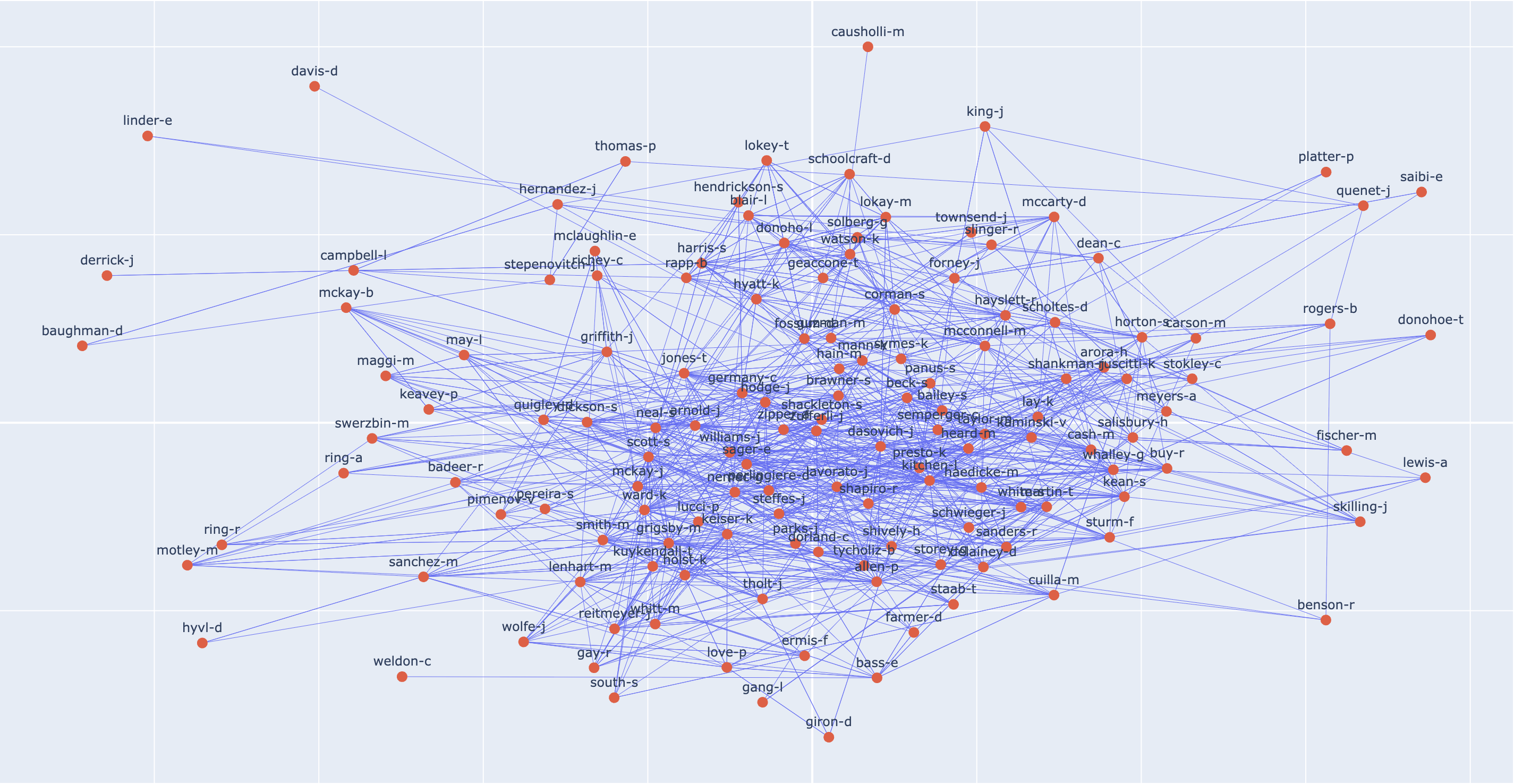
In this project, we focus on the subset of 150 executive-level employees, transforming their email traffic into a directed social network. By examining this network’s structure and evolution, we aim to surface communication patterns that might signal emerging crises. We then layer in Natural Language Processing—tracking sentiment over time and multi-word phrases for most influential executives—to explore whether early warning signs of malfeasance can be detected before it’s too late.
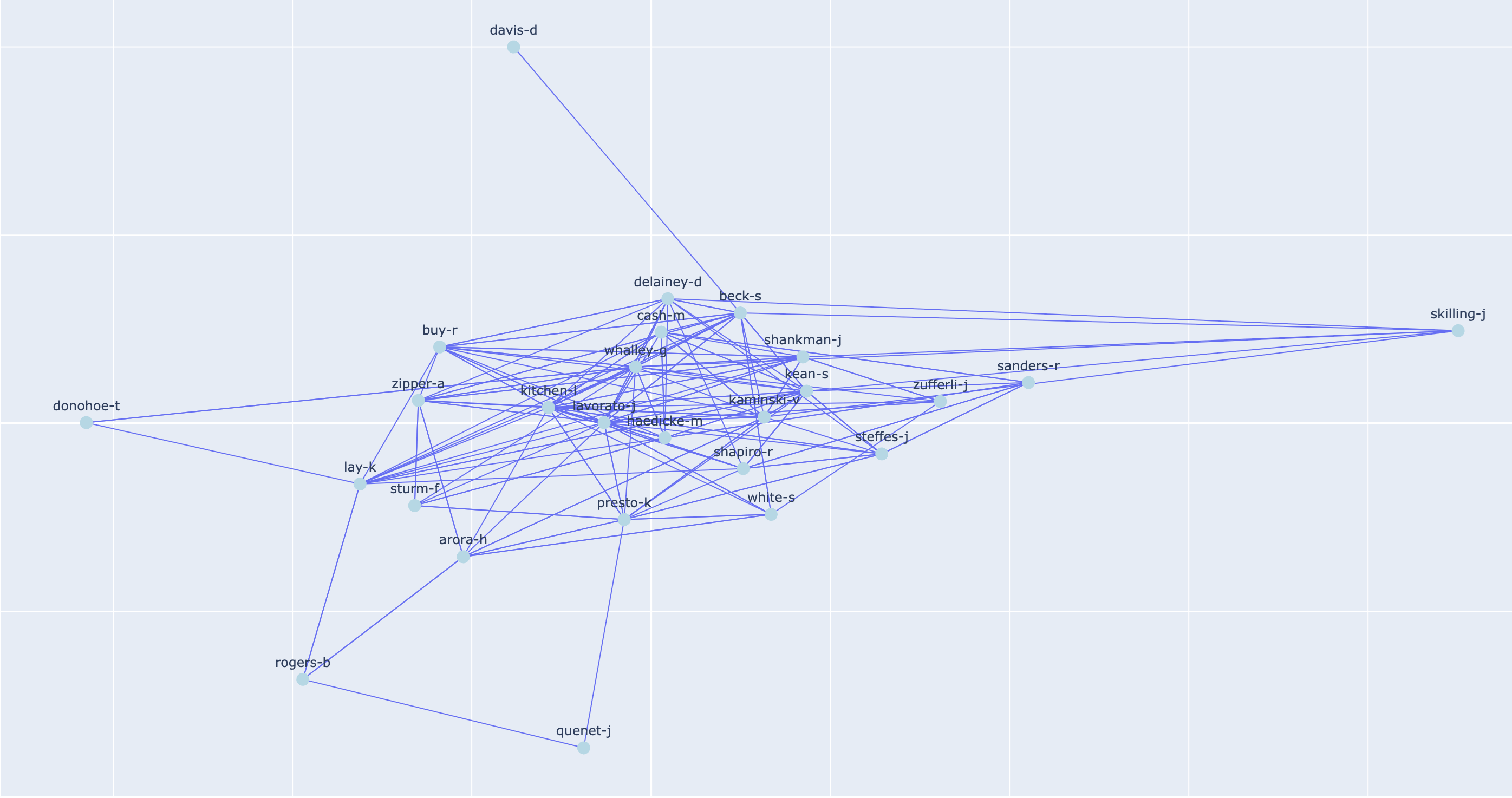
Figure 1. Graph of the complete network of all executives.
To uncover the key players and structural dynamics within Enron’s executive communication network, we apply three complementary techniques:
Eigenvector Centrality Eigenvector centrality measures an executive’s importance by not only counting their direct connections but also weighing how well-connected those contacts are—so it highlights individuals whose influence spreads through the network’s most central figures.
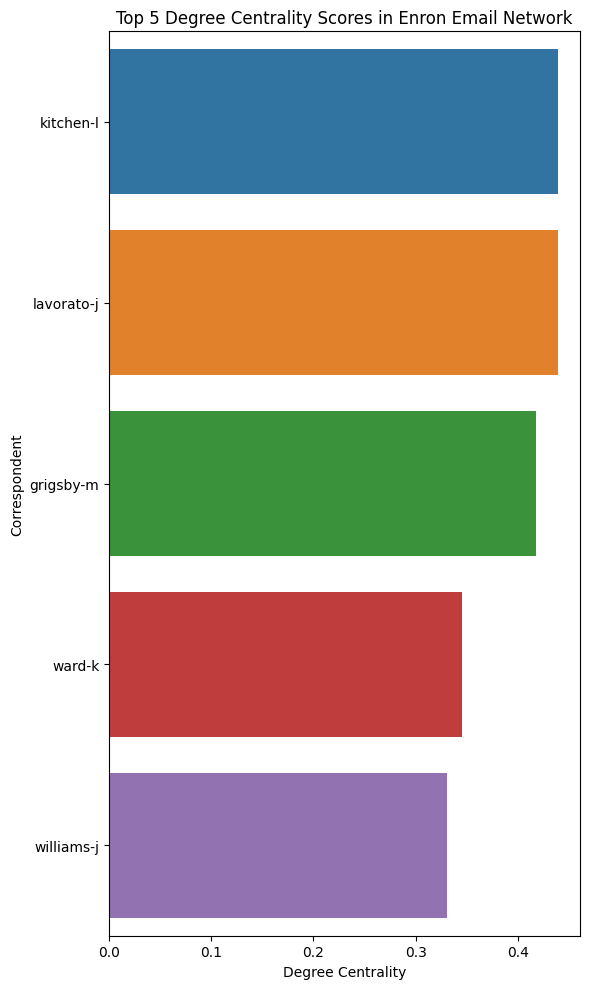
Degree Centrality (in- and out-degree) reveals who sends the most messages and who receives the most, offering a quantitative measure of activity and visibility.
Betweenness Centrality
Betweenness quantifies how often a node lies on the shortest paths between pairs of others. High-betweenness individuals serve as “bridges” or information bottlenecks—critically positioned to control the flow of knowledge or to detect and potentially obscure sensitive topics.
Together, these methods allow us to pinpoint not only the most influential or active individuals but also the structural gateways and subgroups that shape information flow—and potentially conceal it—within Enron’s executive ranks.
Below we compare the top 5 nodes by degree centrality and eigenvector centrality side by side to highlight the most connected and most influential communicators.
 |
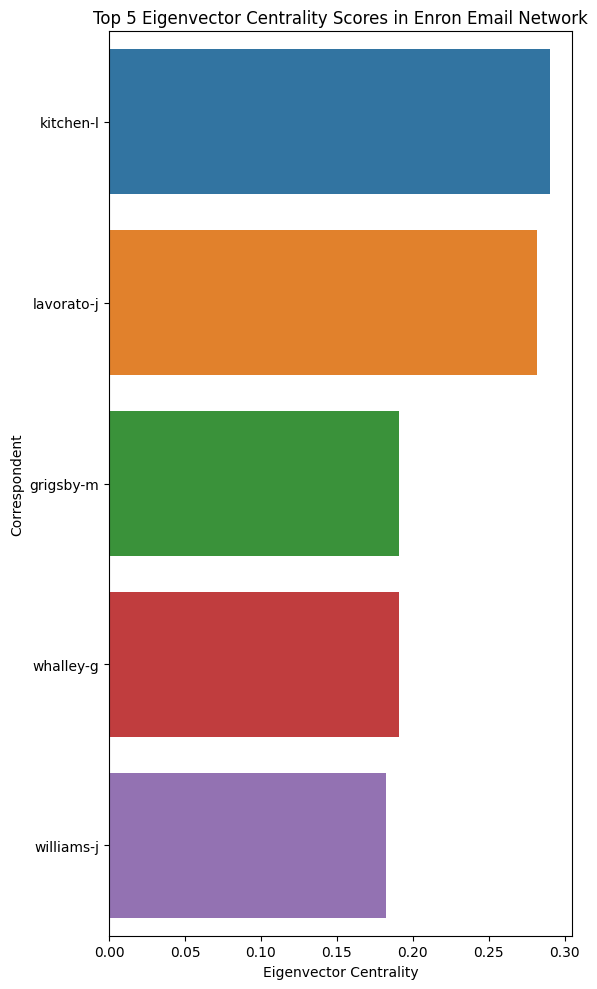 |
Both charts highlight kitchen-l and lavorato-j as the network’s primary hubs—high‐volume communicators whose partners are also highly connected. The swap between ward-k (high message count) and whalley-g (strategically influential ties) in the fourth spot illustrates that sheer activity (degree) doesn’t always equate to influence (eigenvector). Overall, combining these measures reveals both the busiest and the most impactful actors in Enron’s executive email network.
Betweenness centrality shows which employees act as bridges on the shortest paths between others—key for detecting information bottlenecks.
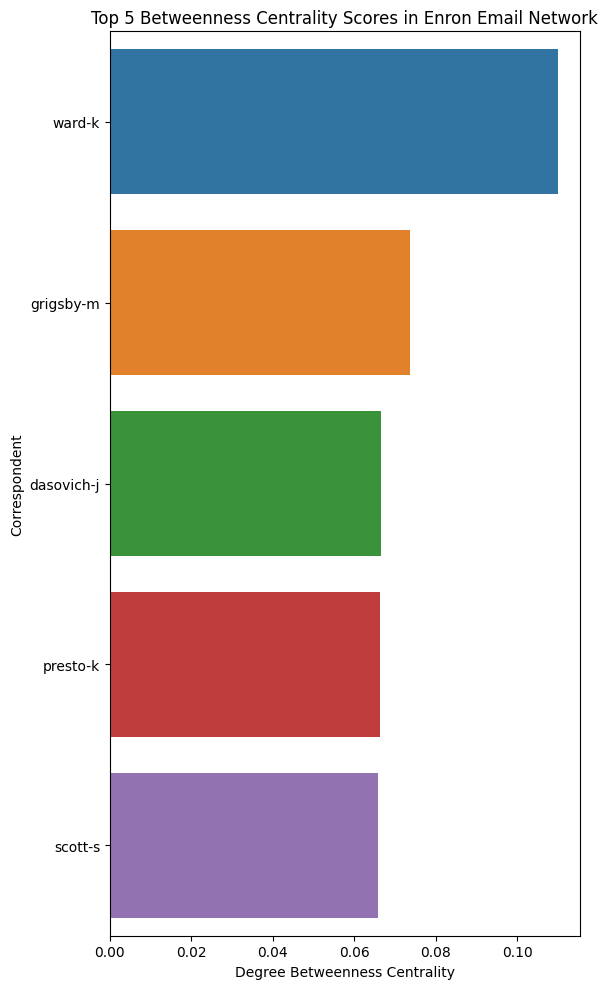
The betweenness chart highlights ward-k as the primary “bridge” in the network—positioned on the most shortest paths between executives. Following him, grigsby-m, dasovich-j, presto-k, and scott-s also serve as key intermediaries. These individuals are crucial for information flow, acting as gatekeepers who connect otherwise distant clusters within Enron’s executive communications.
Using the Louvain algorithm, we identified six distinct communities in the Enron executive network. The node with the highest degree centrality was John Lavorato, Enron’s COO. Intriguingly, his community also included Kenneth Lay and Jeffrey Skilling—both of whom were later convicted of fraud and insider trading and served prison sentences.
Sentiment analysis is the process of automatically determining whether a piece of text expresses a positive, negative, or neutral attitude. By scoring the emotional tone of written language, it lets us quantify how people feel—whether they’re upbeat, anxious, or somewhere in between. For our Enron project, we used a lexicon-based approach via TextBlob’s sentiment polarity analyzer:
By using this lexicon-based approach, no training data is needed and it gives a clear, continuous measure of tone that we can track over time.
In the network analysis phase, we computed betweenness centrality for every employee (node) in the Enron executive‐email graph. For this natural language processing part of the analysis we focus on the 10 highest betweenness individuals. We call these individuals our top hubs. By focusing only on the top hubs, we focus on the most strategic information brokers. Tracking sentiment on Enron’s key decision makers and gatekeepers outgoing mail only, filtering out background noise of the entire employee base.
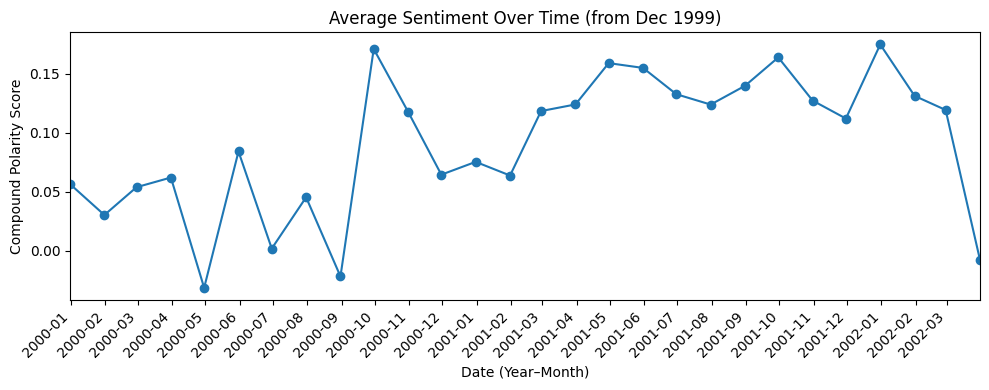
We see on the plot that the overall trend is positive (score > 0). This could be due to the corporate tone bias. Executive email tends to skew polite, upbeat, and solution-oriented. Even bad news is couched in neutral or euphemistic language (“we’ll need to revisit these numbers” rather than “this is a disaster”), so polarity scores rarely plunge far below zero. In reality a sentiment polarity score of 0.05 to 0.15 is in the lower end for a company.
Although Enron filed for bankruptcy on December 2, 2001, our monthly averages don’t show a steady decline beforehand because top executives were still using controlled, neutral‐to‐positive corporate language in their internal emails—focusing on damage control and jargon rather than panic—and any isolated “worried” messages were smoothed out when averaged over hundreds of monthly communications. The decline from 2002-02 to 2002-03 is due to insuffcient amount of emails in march 2002.
Another factor to consider is that TextBlobs sentiment polarity score uses a general-purpose sentiment dictionary that isnt necessarily tuned for corporate jargon. Words like “restructuring” or “liability” may get neutral or lightly scored values, even when they carry heavy negative connotations in an earnings call or legal context. TextBlob also treats each word independently and averages them, so it wont catch irony or the subtle framing, top executives use to soften bad news. Furthermore if an email is just “Approved.” or a long, detailed memo, its overall score tends to stay neutral, so any urgent words hidden in the middle can go unnoticed.
In this section, we surface each executive’s most distinctive vocabulary using TF–IDF (Term Frequency–Inverse Document Frequency). TF–IDF highlights words that appear frequently in one person’s emails but are rare across the broader group, revealing the topics each hub truly focuses on whether that’s regulatory affairs, power trading, or pipeline tariffs. By comparing these keyword profiles, we gain a clearer view of who drives what conversations within Enron’s leadership network.
Below are the top 10 distinctive terms and the primary role of each of our top-10 hub executives. Common stopwords, personal names, and email artifacts have been removed to focus on their core business topics:
| Hub | Top 10 TF–IDF Terms | Role |
|---|---|---|
| dasovich-j | edison, california, assembly, power, state, said, best, davis, senate, energy | VP, Government Affairs (California) |
| forney-j | texas, smith, address, load, thanks, control, working, know, phone | ERCOT Operations Manager |
| grigsby-m | mail, gas, thanks, know, afghanistan, let, meeting, taleban, october, tuesday | Gas Market Trader |
| kitchen-l | kitchen, fastow, agency, dkrunnfusz, lon, stock, company, said, partnerships, david | Strategic Partnerships Lead |
| lavorato-j | lavorato, gas, var, kitchen, delainey, enronxgate, october, think, greg, tuesday | COO, Gas Pipeline & Trading |
| presto-k | vepco, trading, hourly, energy, power, day, new, ubs, enron, lavorato | Power Trader |
| scott-s | transwestern, rate, agreement, tariff, commission, ferc, gas, kholst, mary, know | Pipeline Regulatory Manager |
| symes-k | deal, deals, semperger, kroum, dow, like, thanks, jones, know, let | Deal Structuring Manager |
| ward-k | gas, agreement, master, srpnet, shackleton, let, houston, thanks, know, marussel | Gas Supply Agreements Manager |
| williams-j | gas, credit, energy, trading, mexico, monterrey, ncpa, covers, physical, thanks | Mexico Gas Trading Manager |
The TF–IDF results confirm the role of each executive. For example, Joseph Dasovich’s standout terms “California,” “assembly,” and “senate”—highlight his focused work on regulatory affairs, while Louise Kitchen’s “partnerships” and “agency” keywords point to her role in strategic joint ventures and investor relations. On the trading side, John Lavorato’s mix of risk-management language (fx “VaR”) and platform references like “EnronXGate” contrasts with Thomas Presto’s terms such as “hourly,” “energy,” and “Vepco,” reflecting their distinct desks in pipeline operations versus power trading. These stylistic and topical fingerprints not only validate why these individuals emerged as communication hubs, but also set the stage for tracking how shifts in subject matter, like a sudden rise in “audit” or “liability” could signal early signs of internal stress.
Below are the top 10 TF–IDF terms for Kenneth Lay and Jeffrey Skilling, along with their roles at Enron:
| Executive | Top 10 TF–IDF Terms | Role |
|---|---|---|
| Kenneth Lay | stock, grant, company, group, lay, doing, trading, years, monday, meeting | Chairman & CEO |
| Jeffrey Skilling | zero, hope, glad, goal, goes, going, good, goode, governors, grant | COO & CEO |
Kenneth Lay’s keywords—stock, trading, company, meeting, and grant—highlight his focus on corporate governance, financial performance, and executive compensation. Jeffrey Skilling’s terms—hope, goal, zero, glad, and governors—reflect his results-driven, motivational leadership and hands-on operational role. Together, these profiles show Lay steering high-level strategy while Skilling drove day-to-day execution.
Below are the top five bigrams for each of the top 10 hubs, extracted via TF–IDF after removing names and stopwords. By focusing on bigrams—paired words like “power authority” or “strategy meeting”—we capture the specific concepts and partnerships driving each executive’s conversations, offering richer insight than single terms alone (unigrams).
| Hub | Top 5 Bigrams | Role |
|---|---|---|
| dasovich-j | direct access, power authority, cpuc gov, richard shapiro, stranded costs | VP, Government Affairs (California) |
| forney-j | phone numbers, wednesday september, monday august, real time, herndon rogers | ERCOT Operations Manager |
| grigsby-m | strategy meeting, fundamental analysis, analysis strategy, file attached, portland fundamental | Gas Market Trader |
| kitchen-l | dkrunnfusz agency, kitchen lon, forwarded kitchen, dow jones, wall street | Strategic Partnerships Lead |
| lavorato-j | epmi short, issue comes, october lavorato, epmi long, november lavorato | COO, Gas Pipeline & Trading |
| presto-k | hourly index, new albany, meeting vepco, loss calc, non delivery | Power Trader |
| scott-s | negotiated rate, recipients date, holst recipients, attachment follows, inline attachment | Pipeline Regulatory Manager |
| symes-k | dow jones, cross portfolio, jones index, index prices, database access | Deal Structuring Manager |
| ward-k | master purchase, sale agreement, let know, purchase sale, city glendale | Gas Supply Agreements Manager |
| williams-j | louis dreyfus, covers physical, financial trading, best regards, natural gas | Mexico Gas Trading Manager |
The bigram results sharpen our view of each executive’s key concerns by revealing the exact phrases they used most often. For example, Joseph Dasovich’s top phrases—“direct access,” “power authority,” and “stranded costs” underline his engagement with California’s energy regulations and cost-recovery debates. In operations, John Forney’s use of “real time” alongside calendar-anchored alerts like “wednesday september” and “monday august” highlights his focus on monitoring and coordinating grid performance down to the hour. On the deal-making front, Greg Grigsby’s recurring “strategy meeting” and “fundamental analysis” point to his work dissecting market fundamentals and structuring trading strategies.
By surfacing these bigrams expressions, we not only confirm each hub’s expertise but also pinpoint the precise topics, trading platforms, grid alerts, and strategic partnerships, that could serve as early indicators of shifts in Enron’s fortunes.
| Executive | Top 5 Bigrams | Role |
|---|---|---|
| Kenneth Lay | stock option, power trading, trading group, quarterly basis, forward seeing | Chairman & CEO |
| Jeffrey Skilling | yes understand, hendrickson free, group yes, guy sounds, happening ken | COO & CEO |
Lay’s bigrams—like “stock option” and “power trading”—highlight his focus on compensation structures and high-level market strategy. Skilling’s more informal phrases—“yes understand” and “happening ken”—reflect his hands-on, real-time management style and quick operational check-ins.
Our executive-level email graph does more than map who wrote to whom; it exposes the hidden architecture that moved information (and, arguably, influence) around Enron in the years leading up to its collapse. We found the employee with the highest betweenness score was Ken Ward (ward-k), meaning he sits on the greatest share of shortest paths and therefore controls most cross-unit information flow. We also discovered that John Lavorato (lavorato-j) held the highest degree score and belonged to the same community as Jeffrey Skilling and Kenneth Lay, which was an intriguing detail, given that both Skilling and Lay later served prison sentences.
Our sentiment analysis remained consistently above zero largely because executive emails are engineered to sound reassuring—polite, upbeat, and solution-focused—even when discussing bad news. Any genuine anxiety is often couched in neutral jargon and diluted by averaging hundreds of messages each month, so isolated negative tones never drag the monthly mean far below neutral. Moreover, using a generic lexicon (TextBlob) means that corporate specific terms like “liability” or “restructuring” can register as neutral, and the method can’t capture irony or mid-message urgency.
Our TF–IDF unigram and bigram analyses distilled each executive’s core subject matter—unigrams revealing broad domain areas like “trading,” “regulation,” or “energy,” and bigrams uncovering specific phrases such as “power authority” or “strategy meeting.” These term-frequency profiles confirmed the roles of our top hubs and highlighted where their focus lay, but they remain static snapshots. Without a temporal dimension or deeper phrase extraction, they can miss emerging topics or nuanced multi-word phrases, underscoring the need for rolling-window TF–IDF or dynamic topic modeling to capture the first ripples of a brewing crisis. Also Lay’s terms center on strategy and compensation, underscoring his governance role. Skilling’s language is action-focused and immediate, reflecting his operational drive. Together, they highlight the contrast between high-level oversight and hands-on execution. Overall, the TF-IDF combined with unigrams and bigrams were unable to capture emerging crisis or signs of malfeasance as we had hoped.
To build on this analysis, we plan to integrate modern deep-learning techniques—such as fine-tuned transformer models for nuanced sentiment and topic detection, and graph neural networks to model the Enron email network over time. These approaches could enable early warning of structural shifts or emerging crises by combining text embeddings with dynamic network features. Additionally, anomaly-detection models (e.g., temporal graph autoencoders) could flag sudden deviations in communication patterns.
The dataset can be downloaded from Kaggle. Our Code is available on our github
This project was made by Christian Warburg (s225083) and Sofus Carstens (s224959) for the Computational Social 02467.